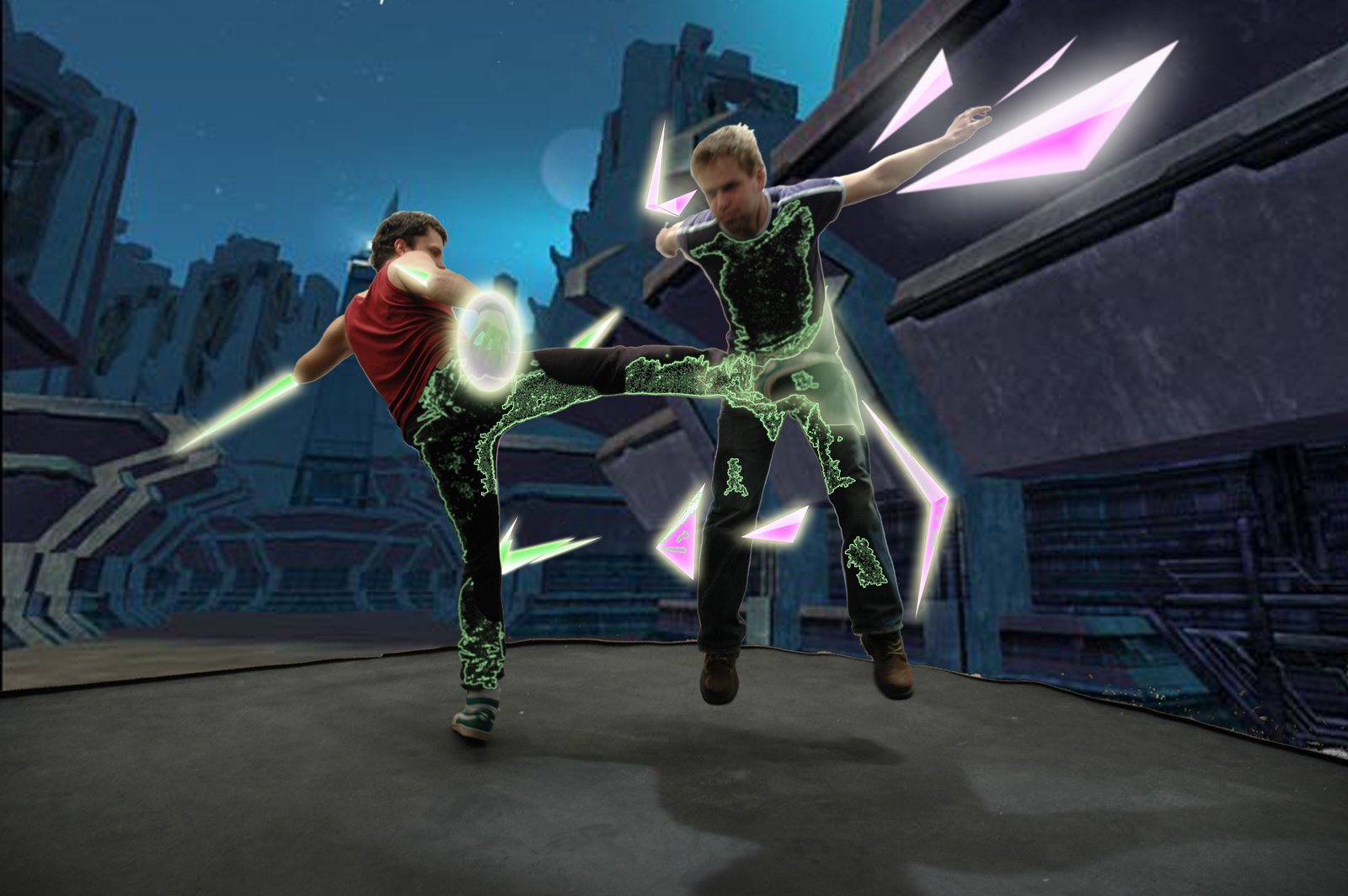
metafighters — the war of images, staged in the aesthetic of the game.
2006 – 2007
The diploma at the Academy of Media Arts Cologne where Florian Kuhlmann opened virtual reality to pop culture — the theory of the hybrid space, and the cluster of works and events that gave it its name.
concept
"The Virtual Reality of the 'Cave' turns into a Social Virtual
Reality that can be accessed through the Net."
— Florian
Kuhlmann, Cave goes Pop Culture, 2007
Virtual reality in itself is nothing new: the data glove and the head-mounted display date back to Ivan Sutherland's work in the 1960s. What changed by 2007 were fast computers and networks and, above all, a gaming industry that had already outstripped Hollywood. With Second Life the surface opened. "The three-dimensional virtual space becomes globally accessible through the Net, and it is growing as a meeting place for millions" — and, unlike other game worlds, everyone can build in it. The cave goes pop.
Kuhlmann's diploma at the Academy of Media Arts Cologne (examined by Dieter Jung, Hans Ulrich Reck and Frans Vogelaar; with an accompanying exhibition at Blue House e.V.) takes this opening as its subject. It reads Second Life not as a game but as a prototype: "to me, Secondlife is rather the prototype for the coming developments of the Net." A spectacular hybrid space has formed in which technology, together with capitalism, has taken on a life of its own. Yet broadcasting is "no longer exclusively reserved to a wealthy elite" — everybody can contribute to the spectacle, and so these globally accessible spaces hold "the potential to serve a cultural development that is not defined by the domination of the spectacle itself."
Around the theory sits a cluster of practice — an exhibition held entirely in-world, two live hybridhappenings, a body of "hybrid living" works, a street performance. Each tests the same question from a different side: what do we make of the surface once it opens?
the theory
"This is the evolution of a hybrid space in which technical and
non-technical reality pervade each other, a space that is both at the
same time."
— Cave goes Pop Culture, 2007
The argument runs from Paul Virilio to Guy Debord. Virtual reality begins as a weapons technology — the control of the electro-magnetic spectrum, the "pure weapons" of the first Gulf War, where the war is won not by destroying the enemy but by disconnecting their space of communication. "Action is not destruction, but... acting as if everything could be and will be destroyed." The same logic — control rather than destruction — returns in the non-lethal weapons of civilian space (the group BBM's crowd-ctrl: "space control is mutating into a bio-strategy"). Inside and outside dissolve: "the tools of control come physically close to us, they grow into us — the controllers, as well as the ones controlled," and a hybrid space forms in which technical and non-technical reality pervade each other.
The other half of the argument is Debord's spectacle. Every commodity is a hybrid of thing and symbol — "industrial production is hybrid-production, a product is a thing and a symbol and the transitions between them are fluid" — and its immaterial part is "the other side of money, the abstract general equivalent of all commodity." In the digital sphere mass production collapses into mere copying, scarcity falls away, and the edition has to be reinvented as a rule set. What the state protects, Kuhlmann notes, comes down to one sentence: "everything correlating financial values is protected by the law." The wager is that the opened surface could become a genuine public sphere rather than a trap.
the diploma exhibition
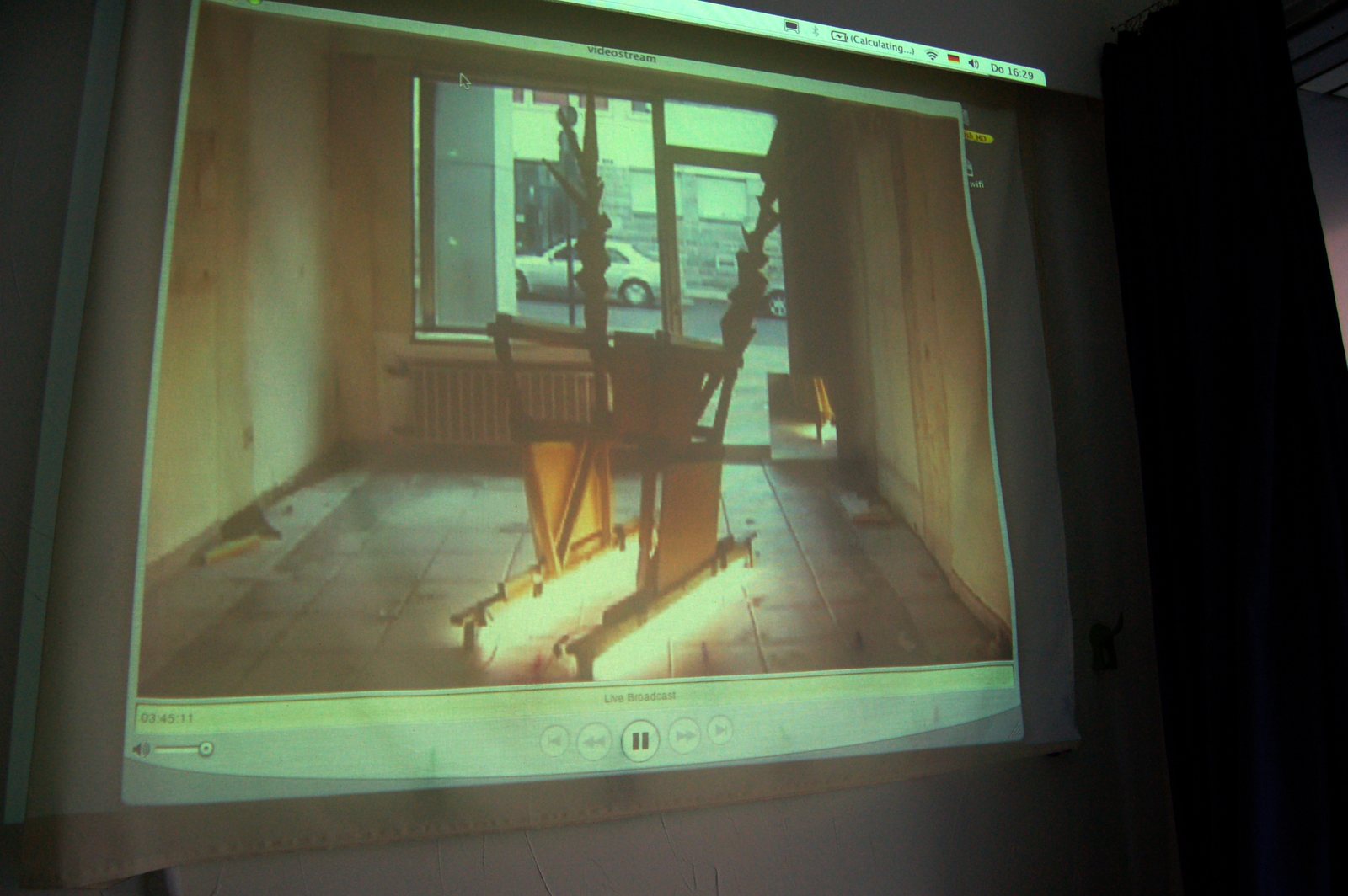
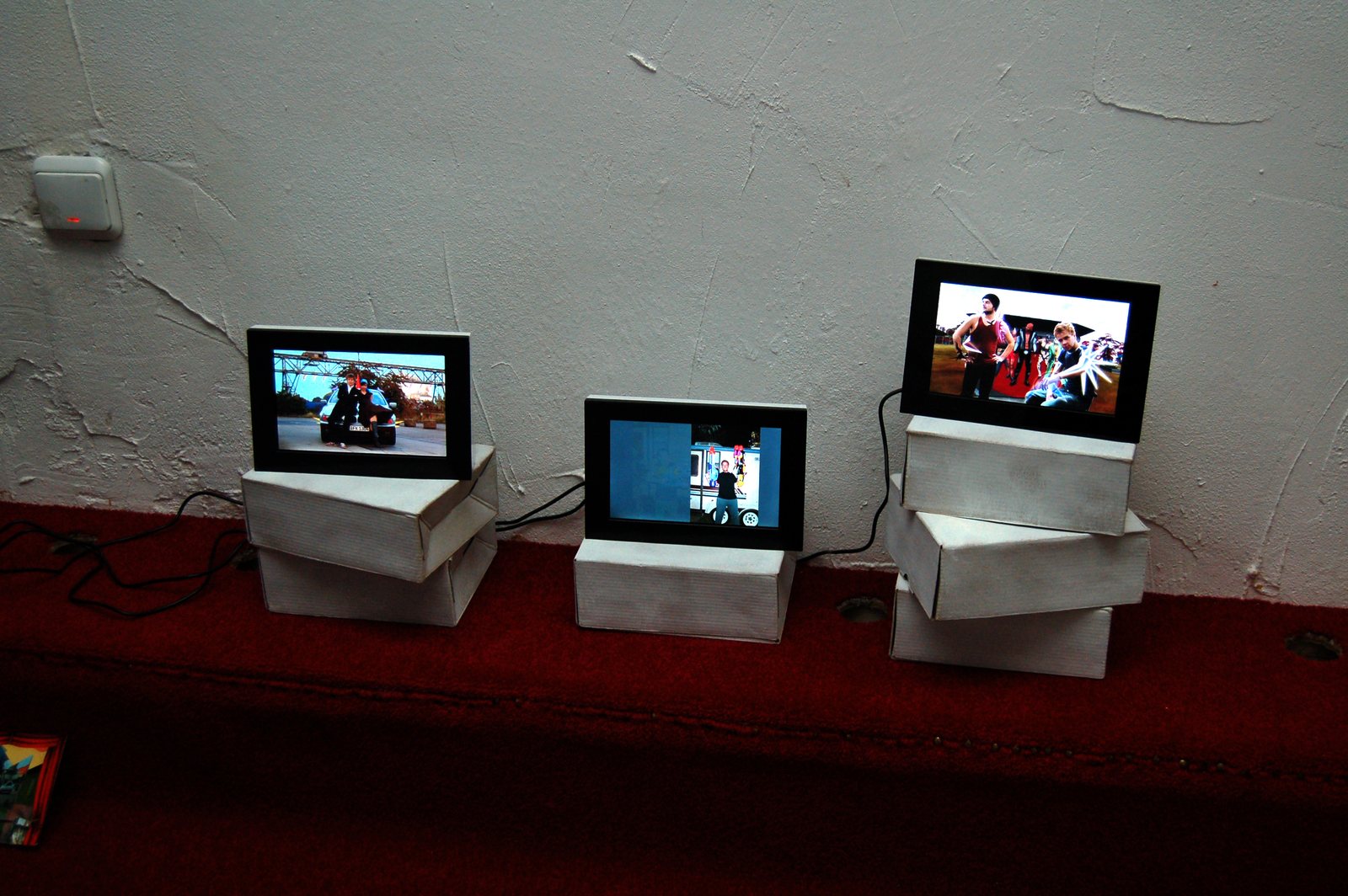
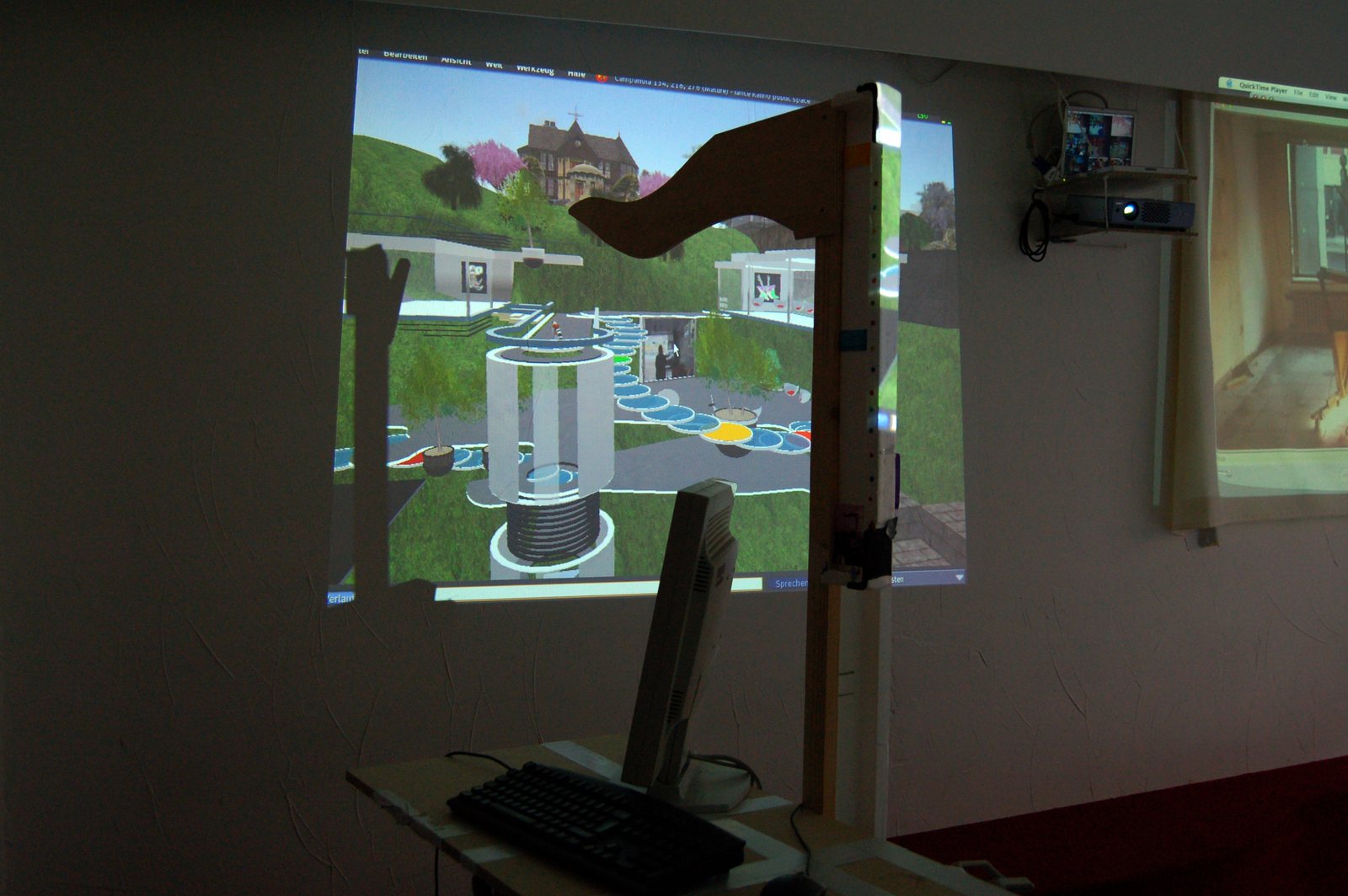
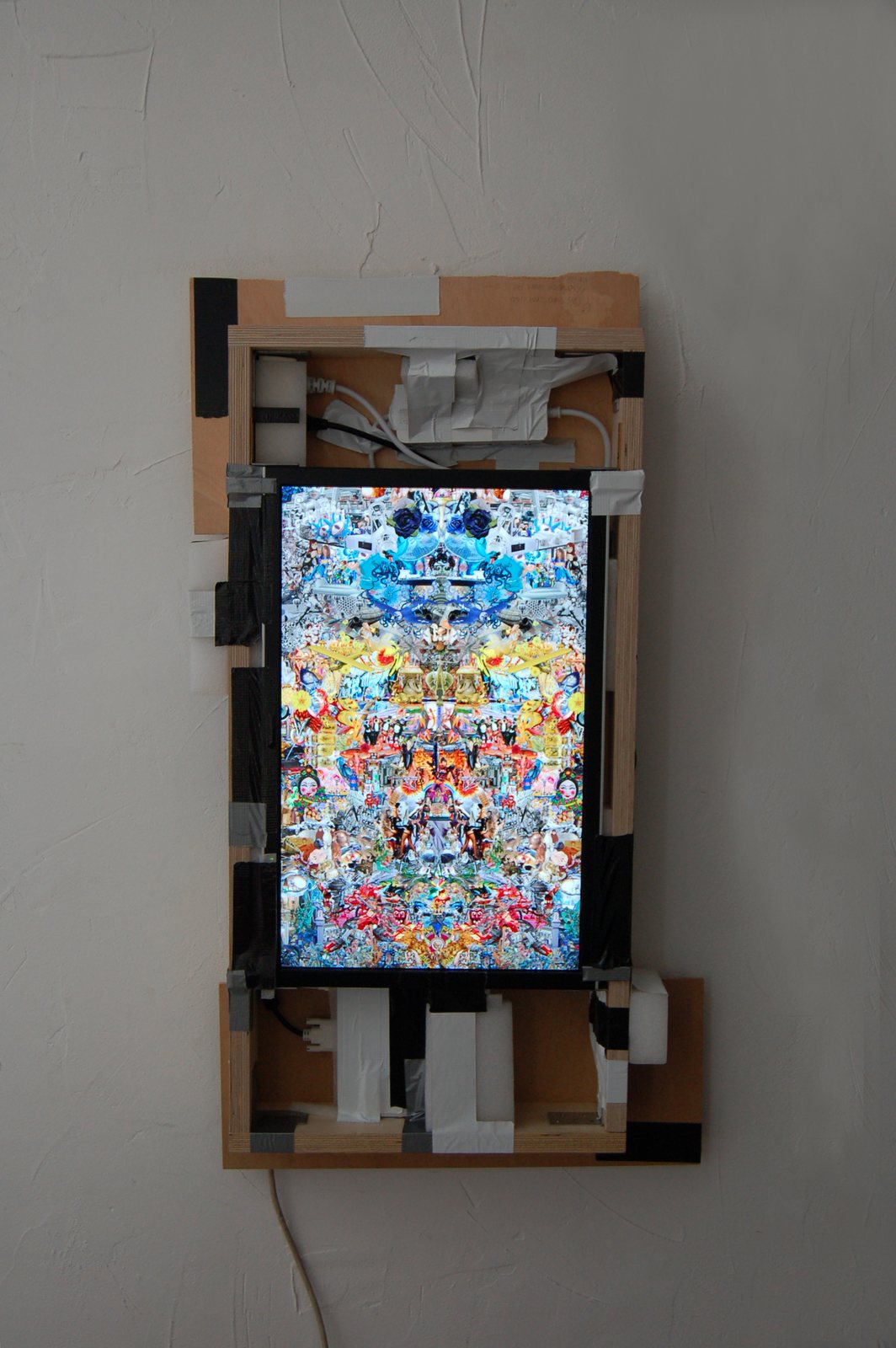
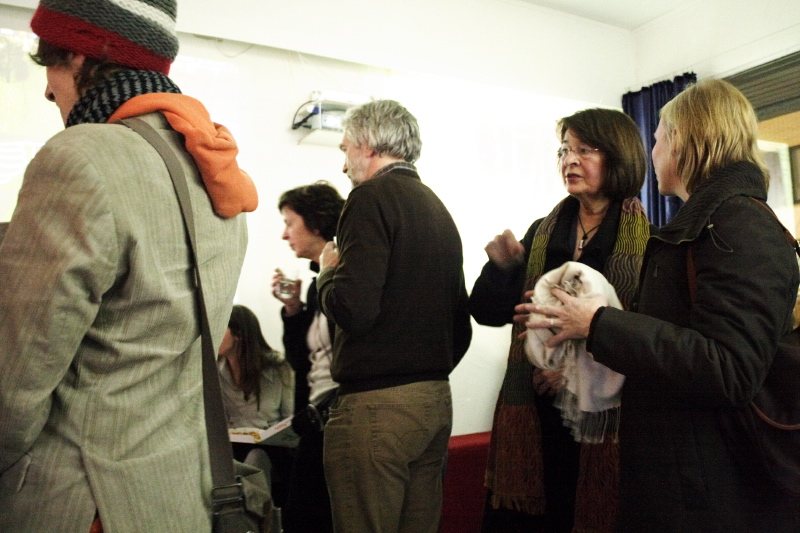
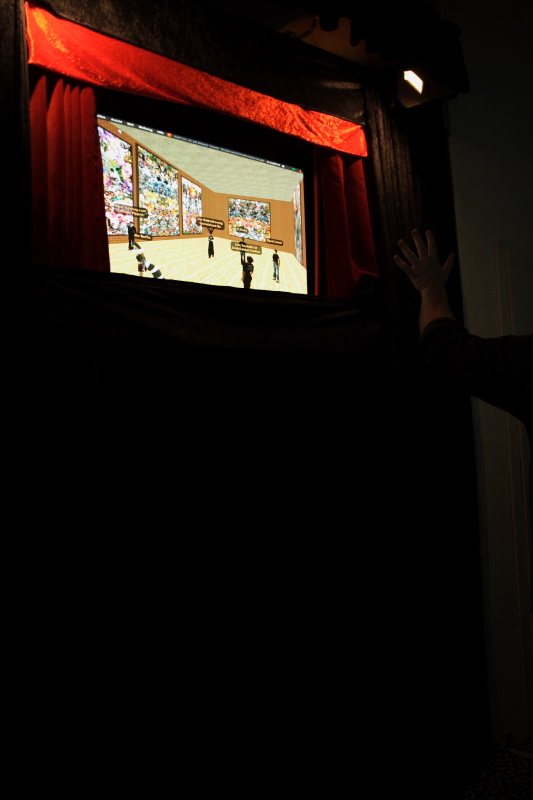
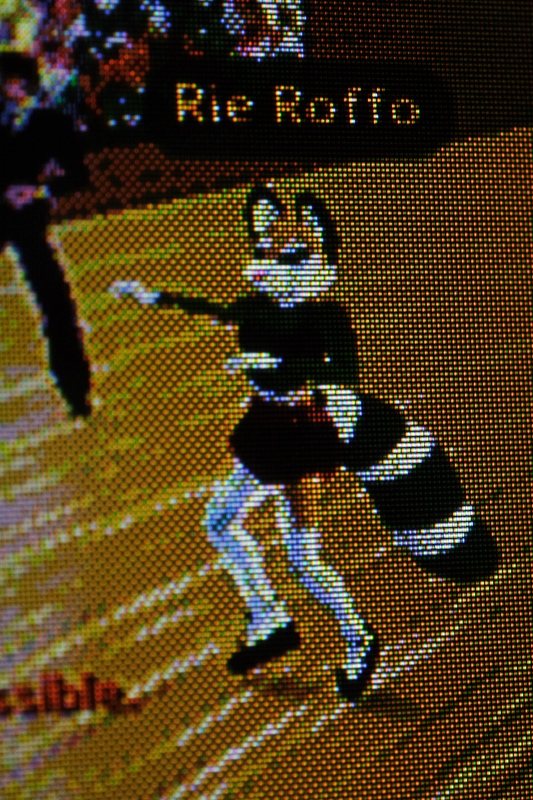
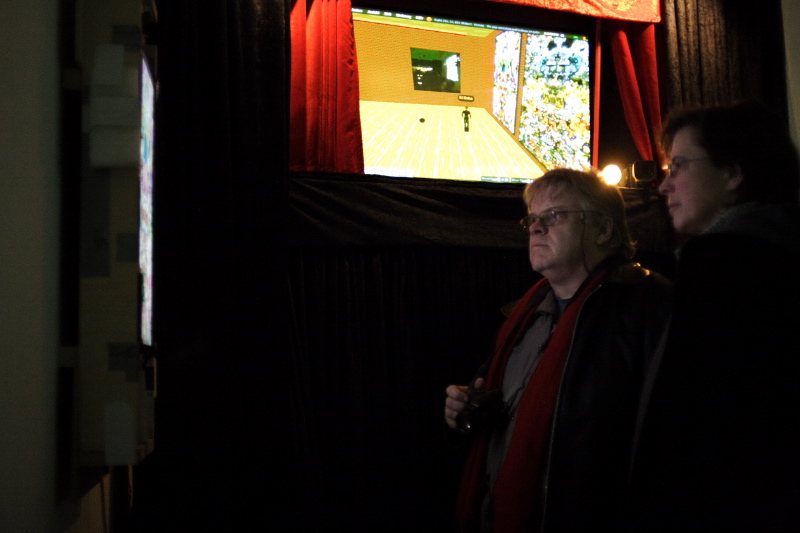
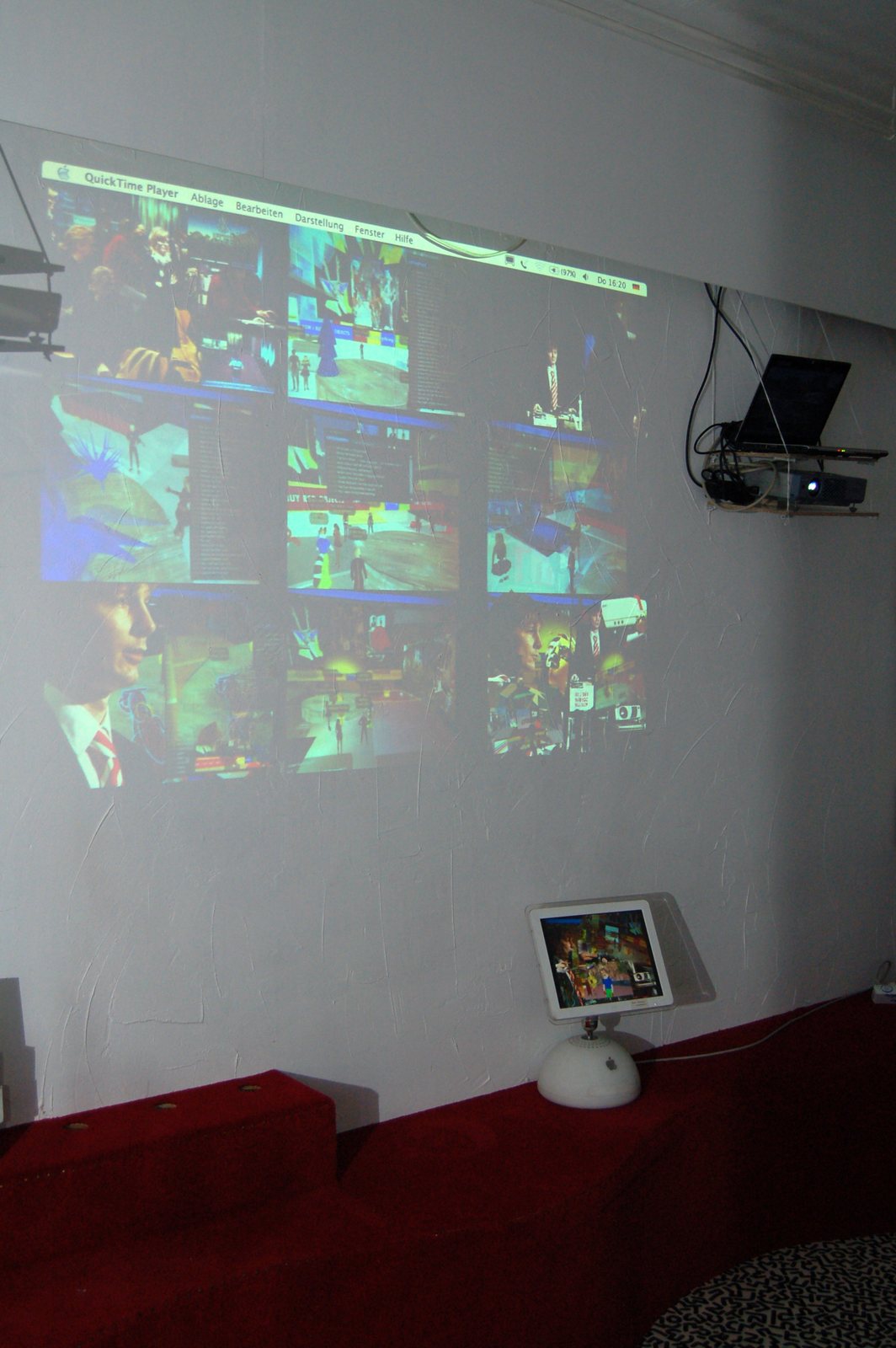
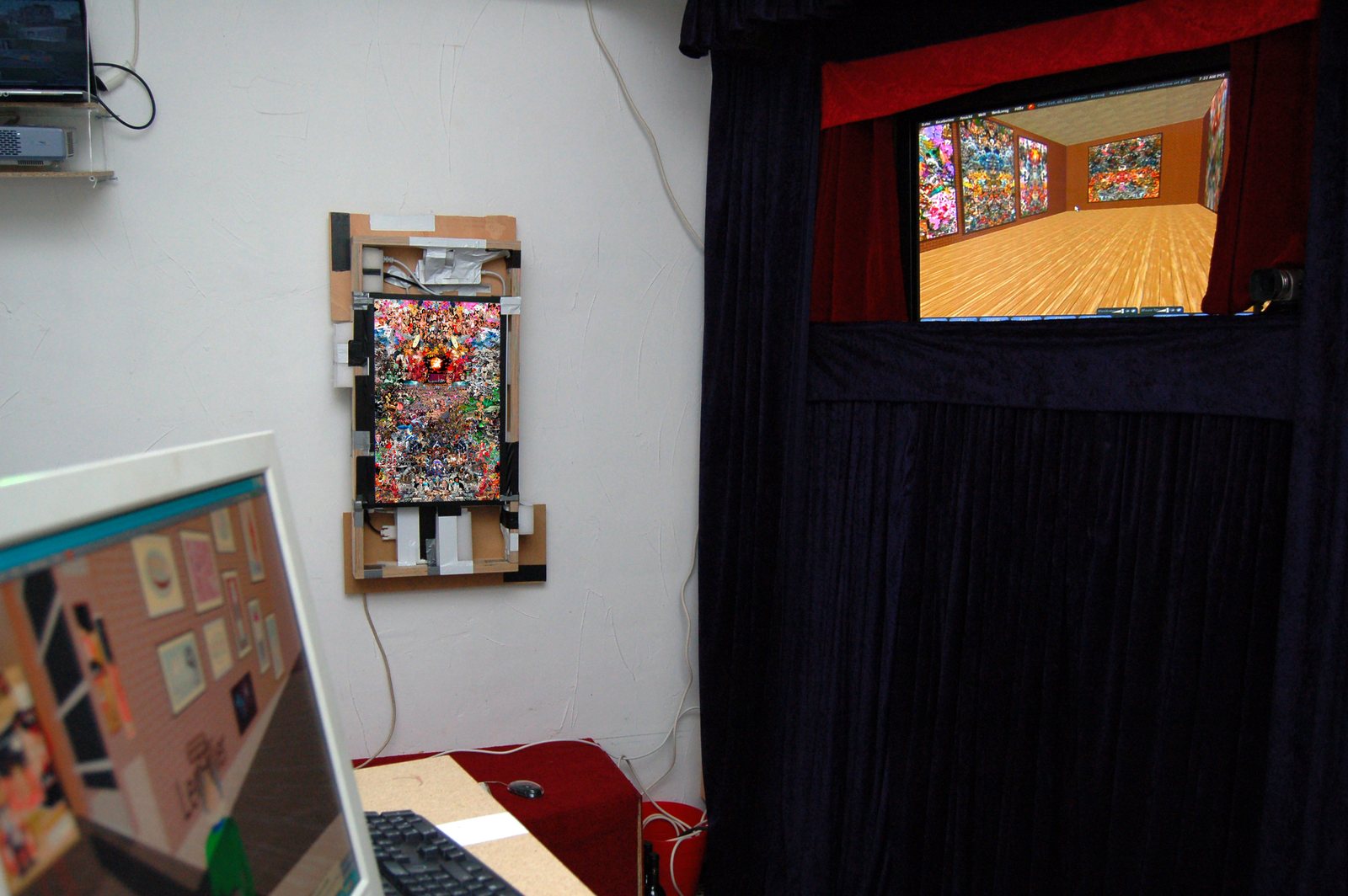
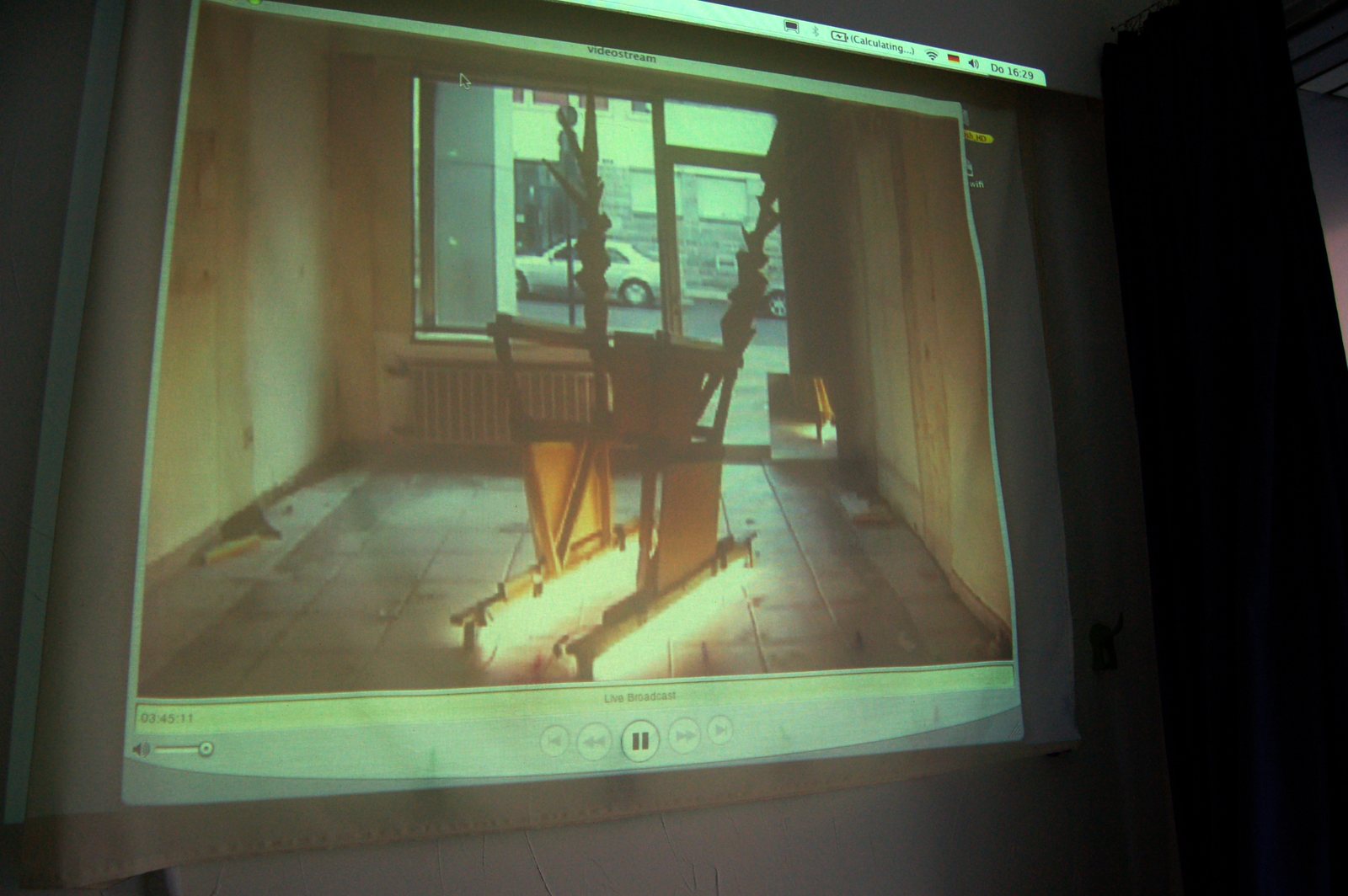
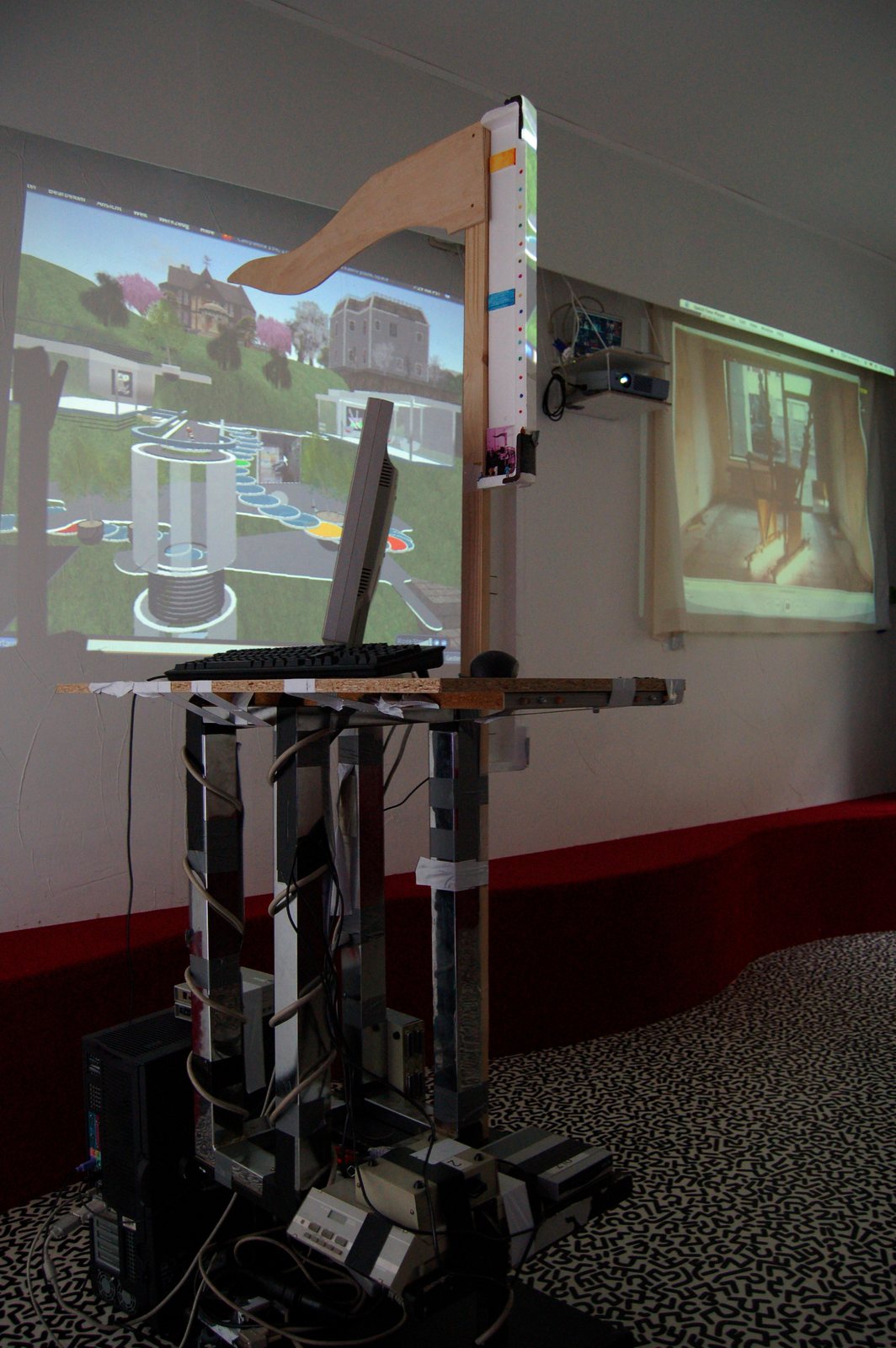
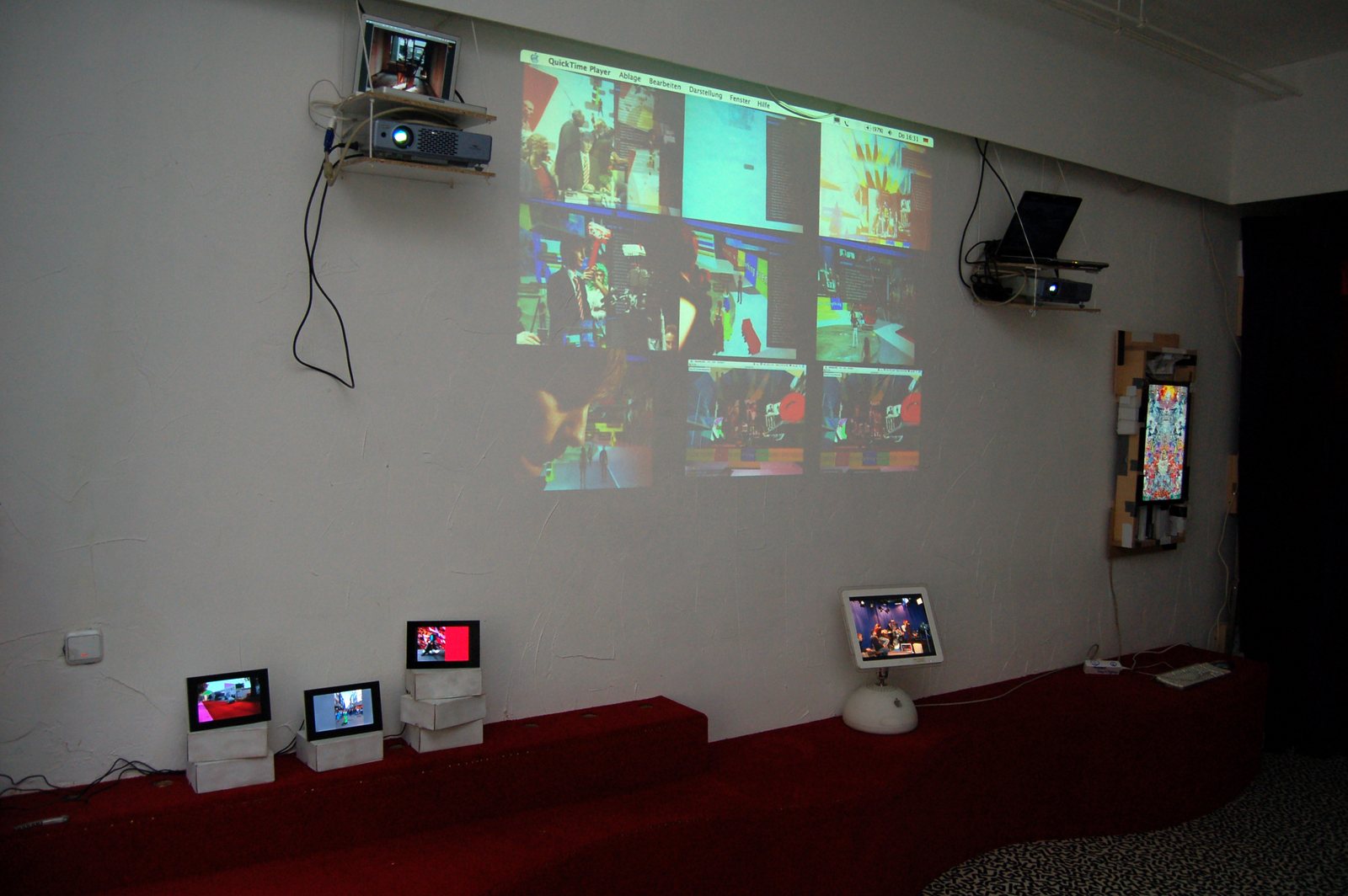
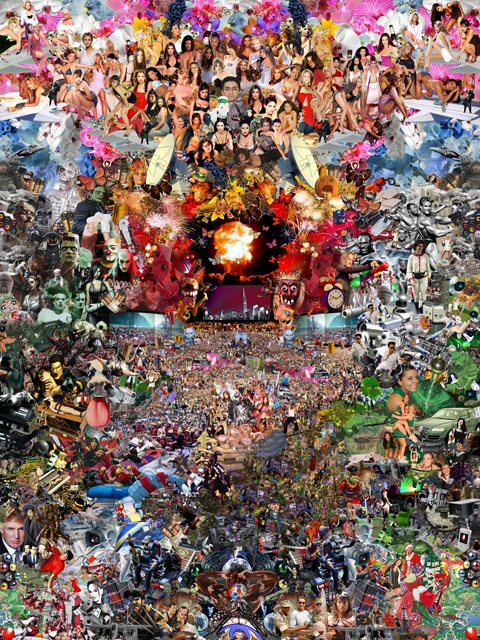
The accompanying show, at the Blaues Haus in Cologne, answered the theory's question in the room: screens on white plinths playing the recordings of the hybridhappenings, the collages held in digital frames, and the Second Life spaces and the throne projected large onto the walls. The digital work, brought back into physical space without pretending to be anything but digital. On the opening night the room filled around the screens — the RGB raccoon on the wall, the red-curtained projection, visitors and avatars in one space.
hybrid living · meta unlimited
"if you want to make money in a hybrid world you need a fast
car and a beautiful woman on your side."
— meta unlimited,
in-world wall text, 2007
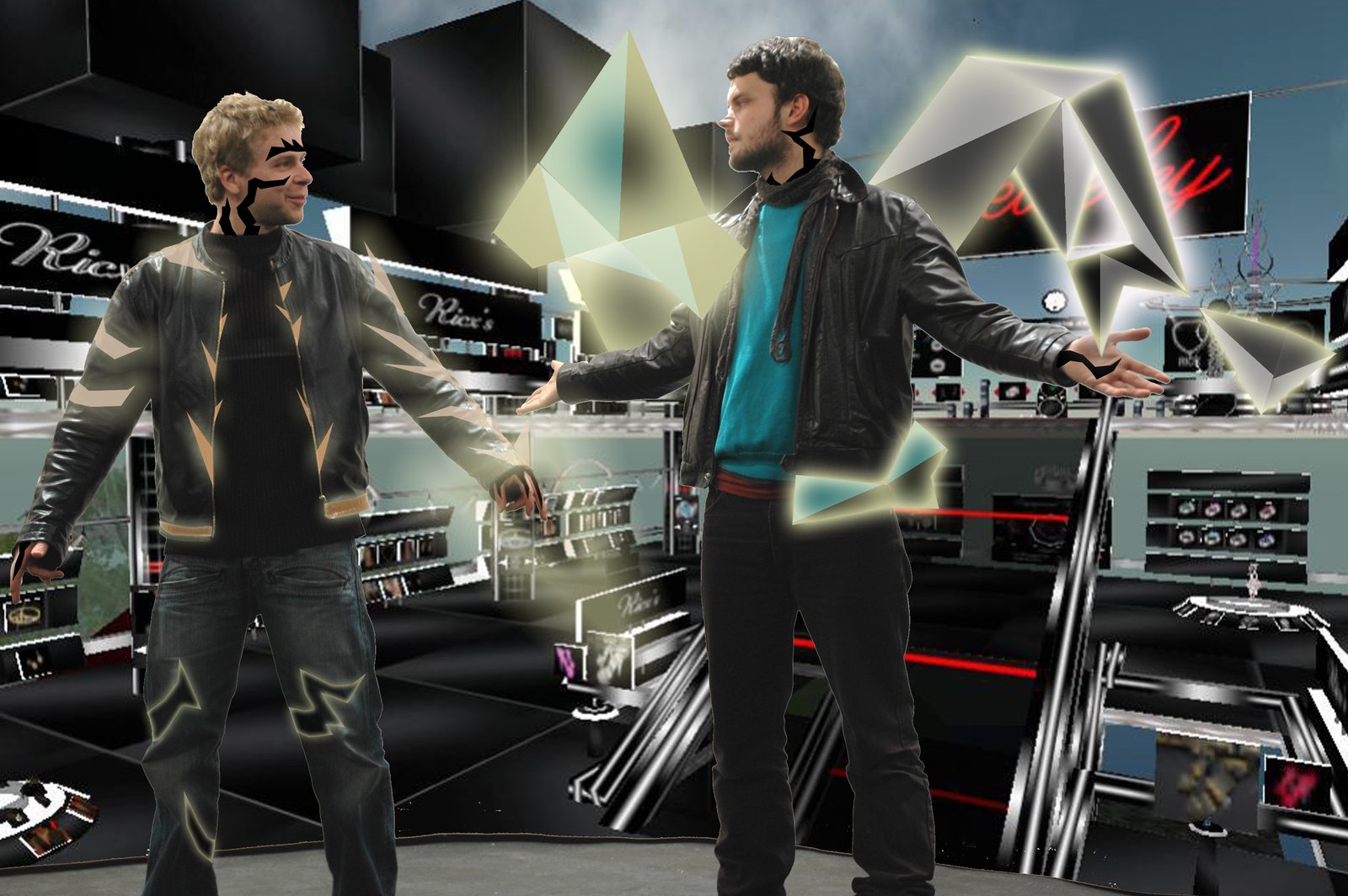
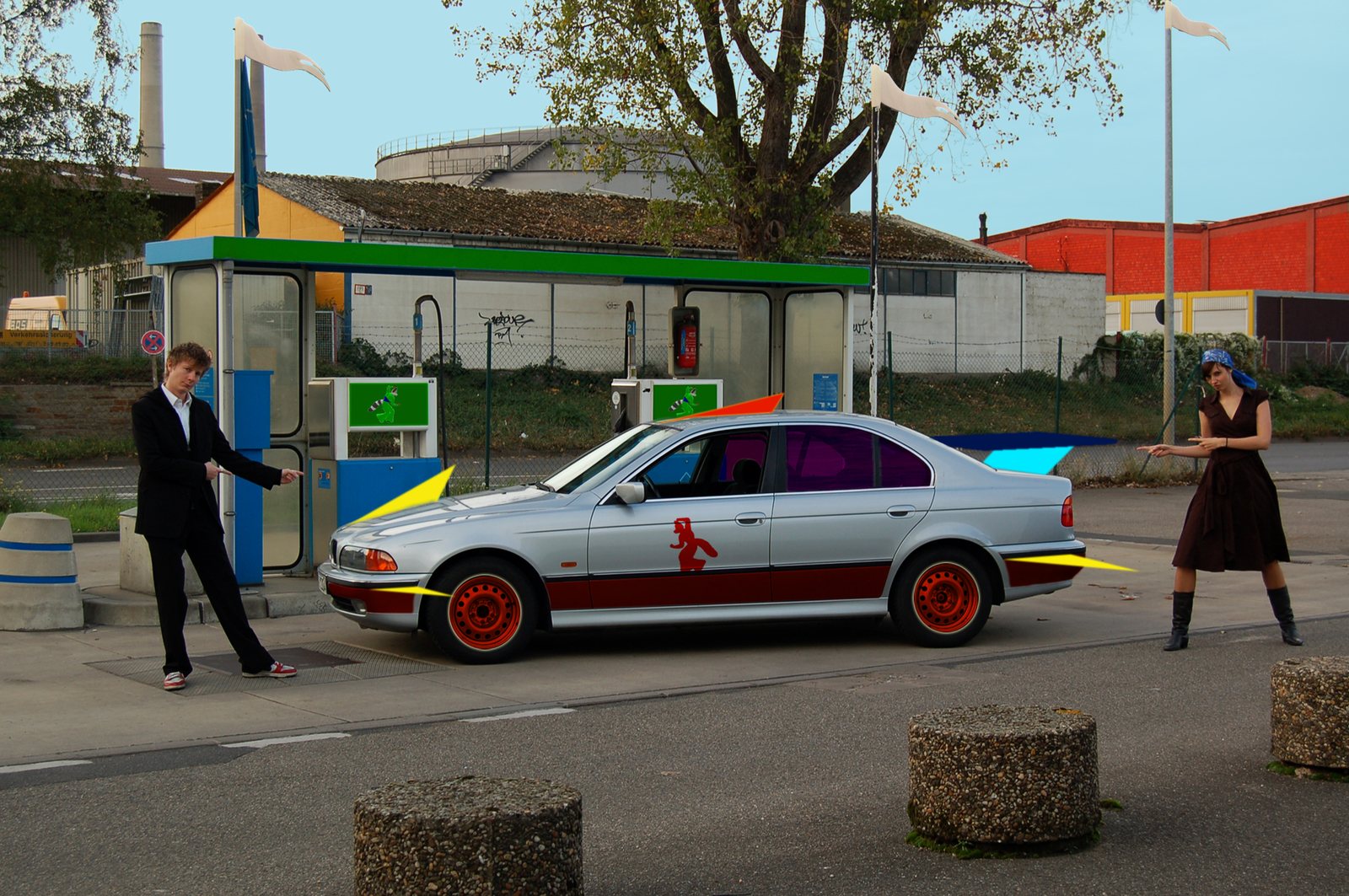
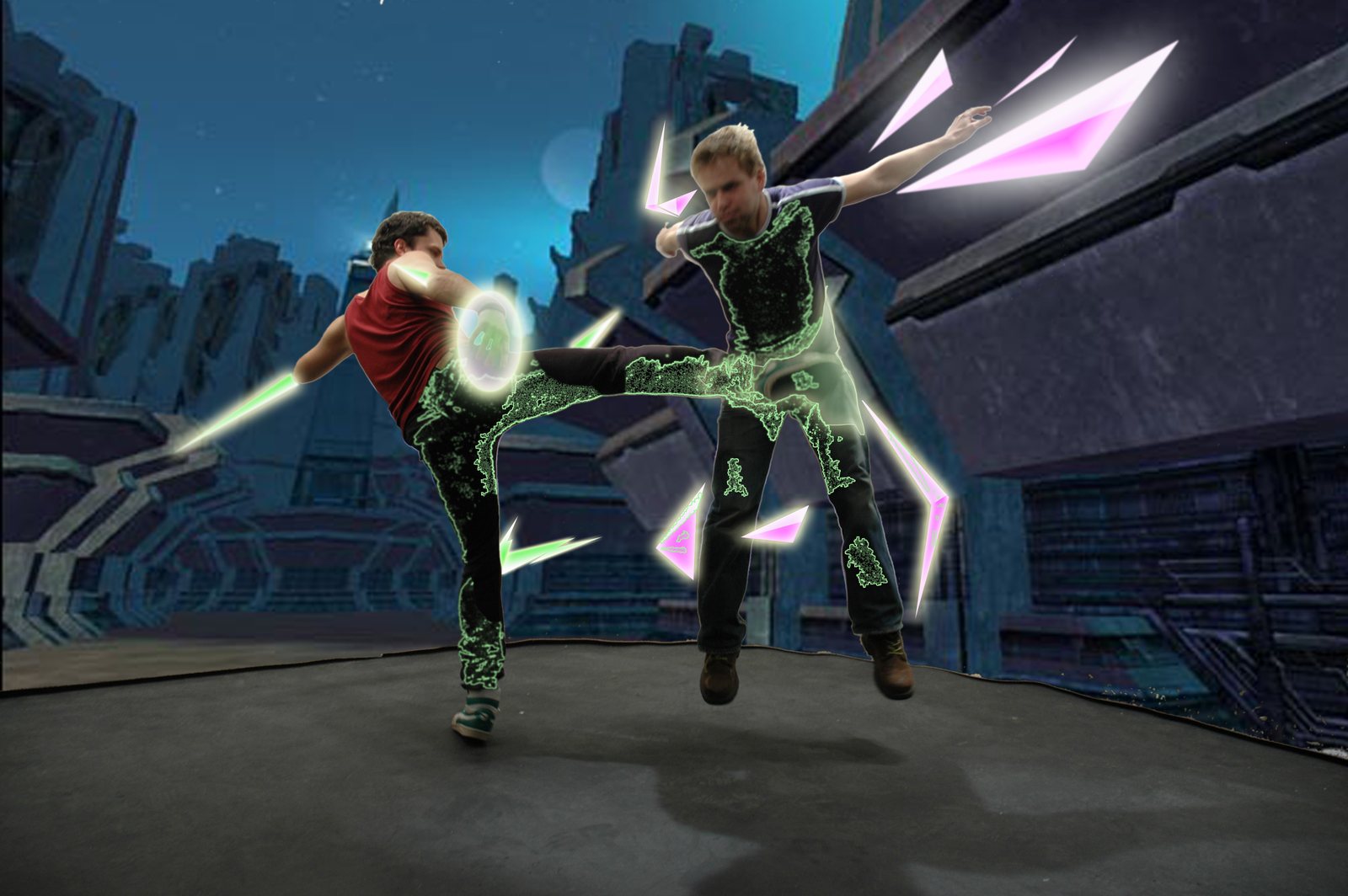
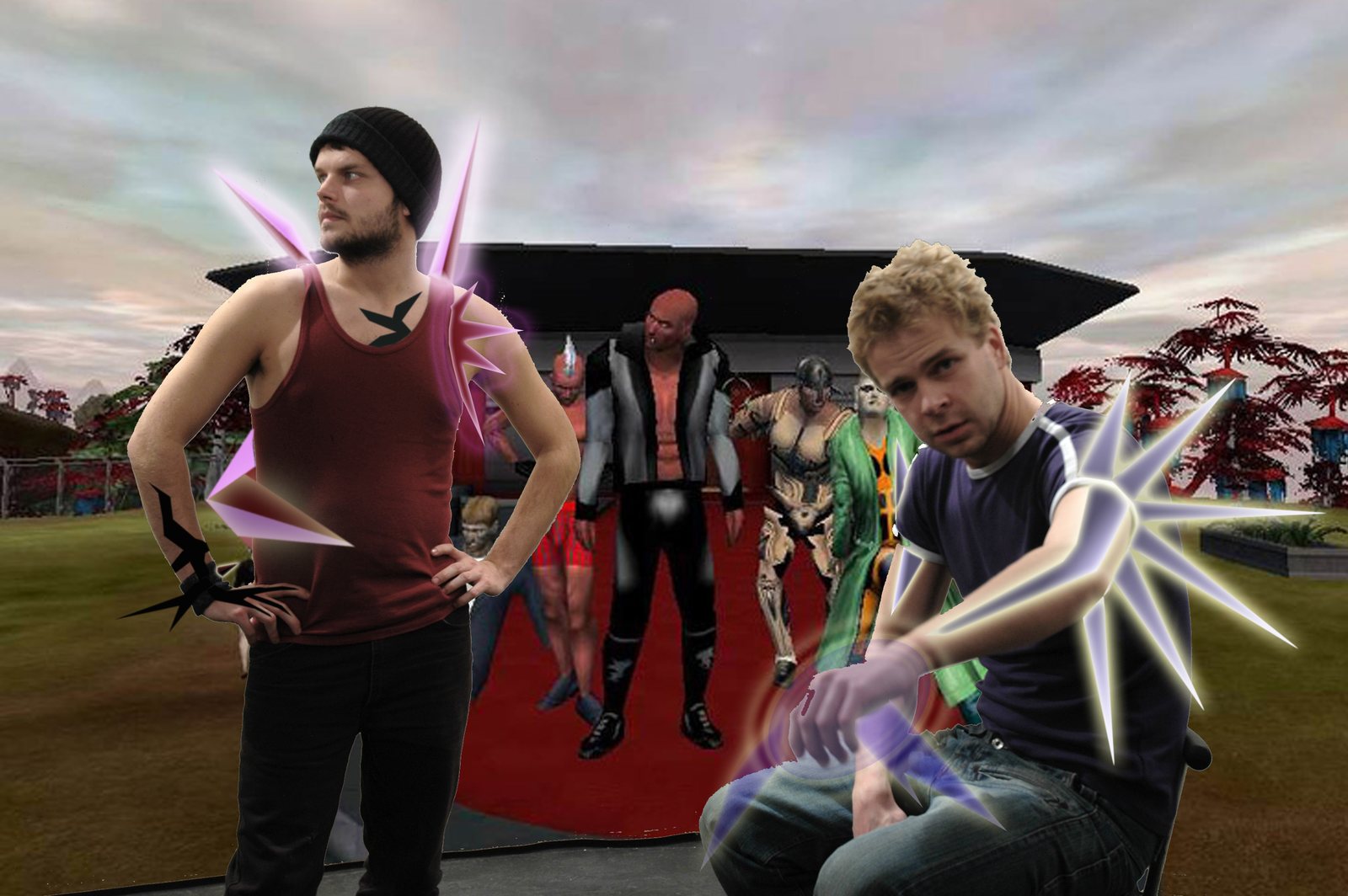
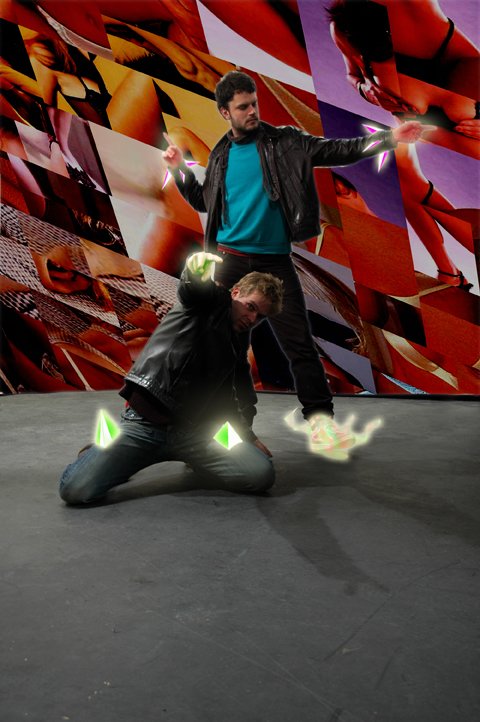
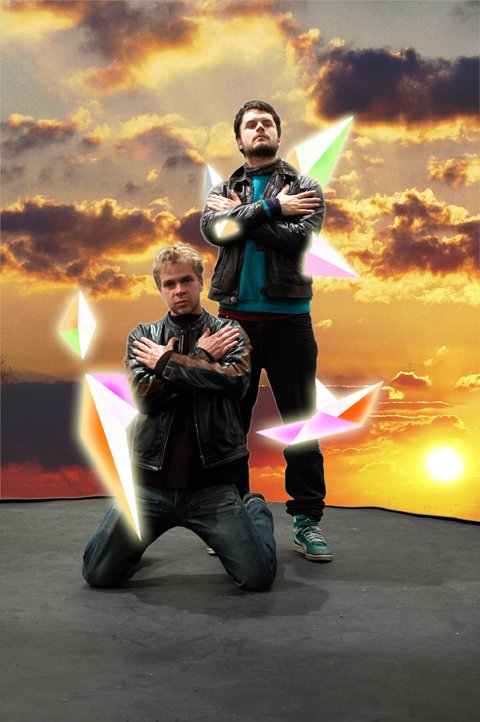
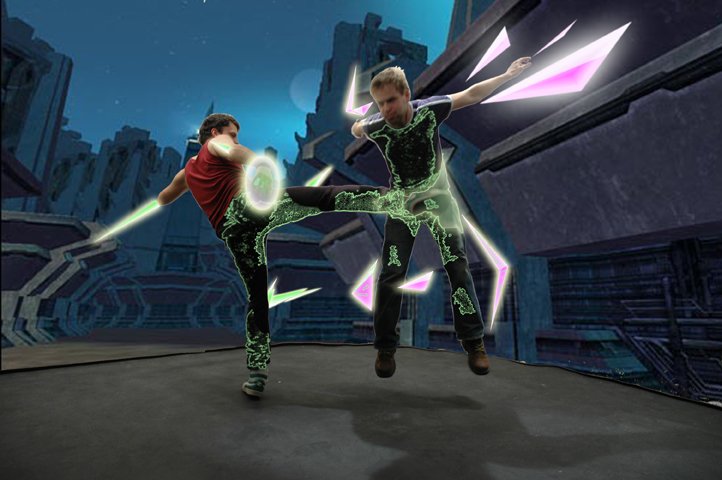
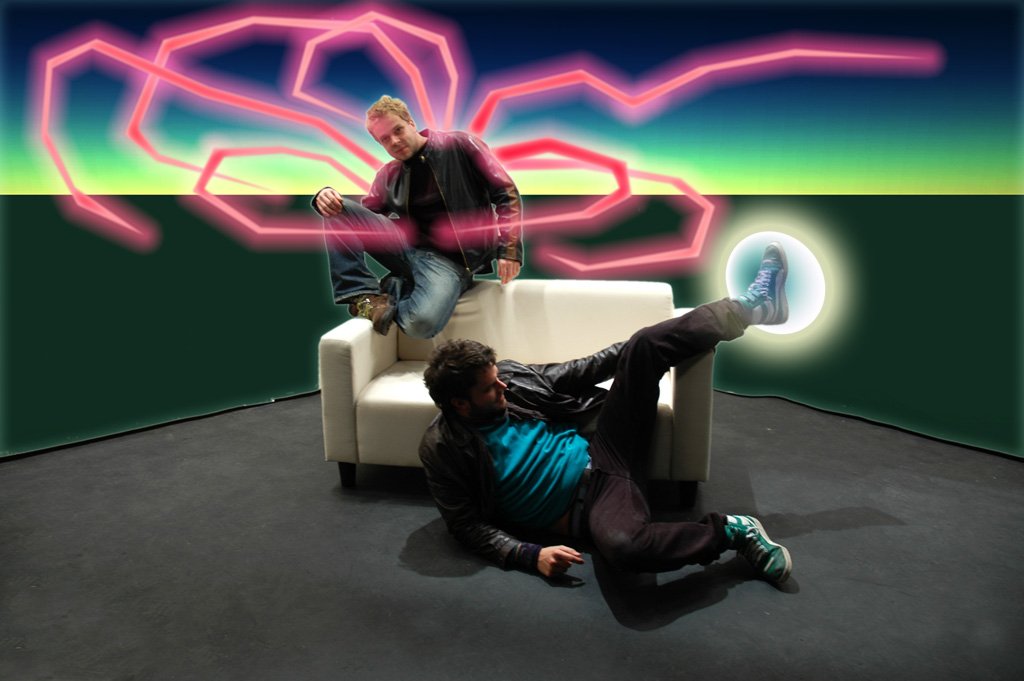
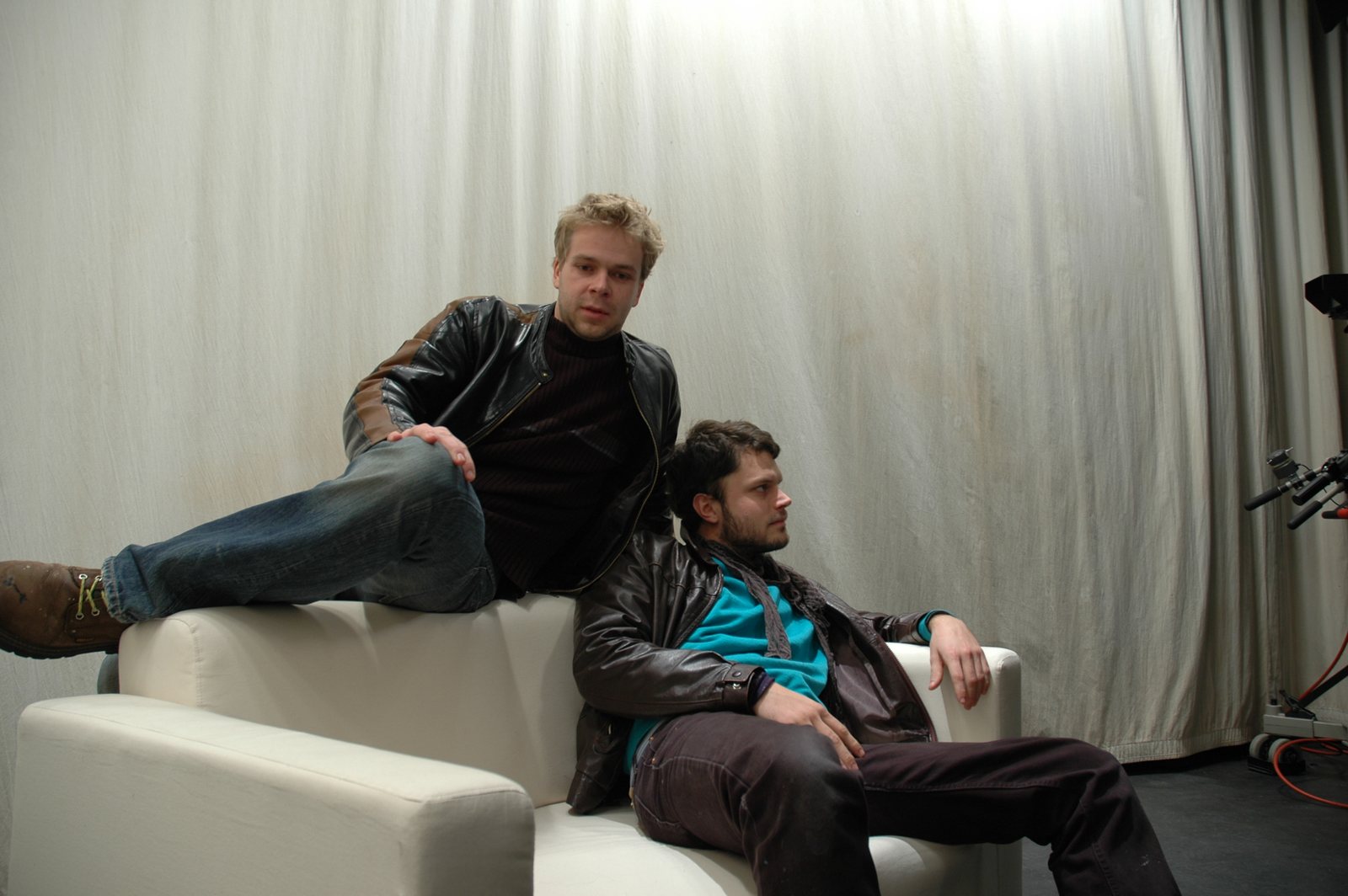
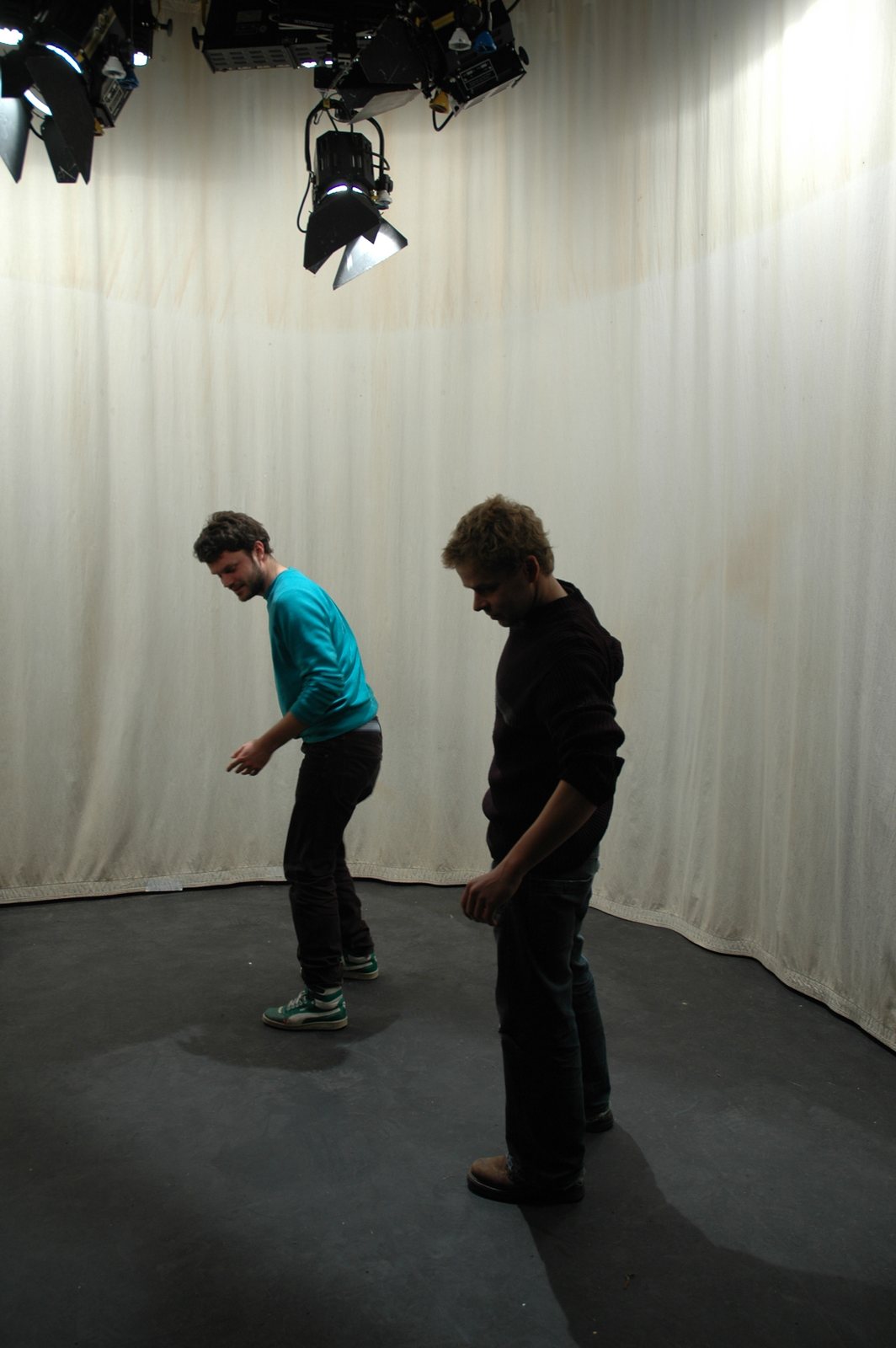
Kuhlmann ran the diploma partly as a company: meta unlimited, art at the interface to business culture and its codes. Its aesthetic is the hybrid life the theory describes — the future as a fashion shoot and a fight scene. The hybrid mode and metafighter works composite studio plates of two posing models with the neon graphics of the game — a fashion shoot staged across a red carpet, a hi-fi showroom, a graffiti wall, a game landscape and a burning sunset; a red-painted car stands at a petrol station as a "hybrid car". Advertising and art game, spectacle and critique, run in the same picture.
performance · hohe straße · september 2006
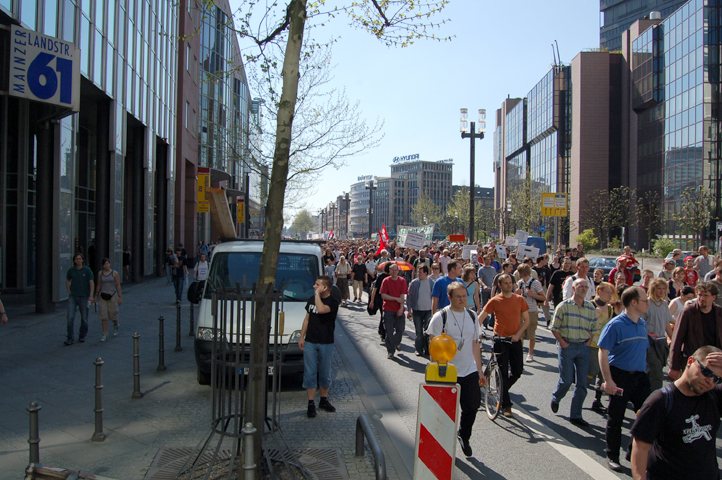
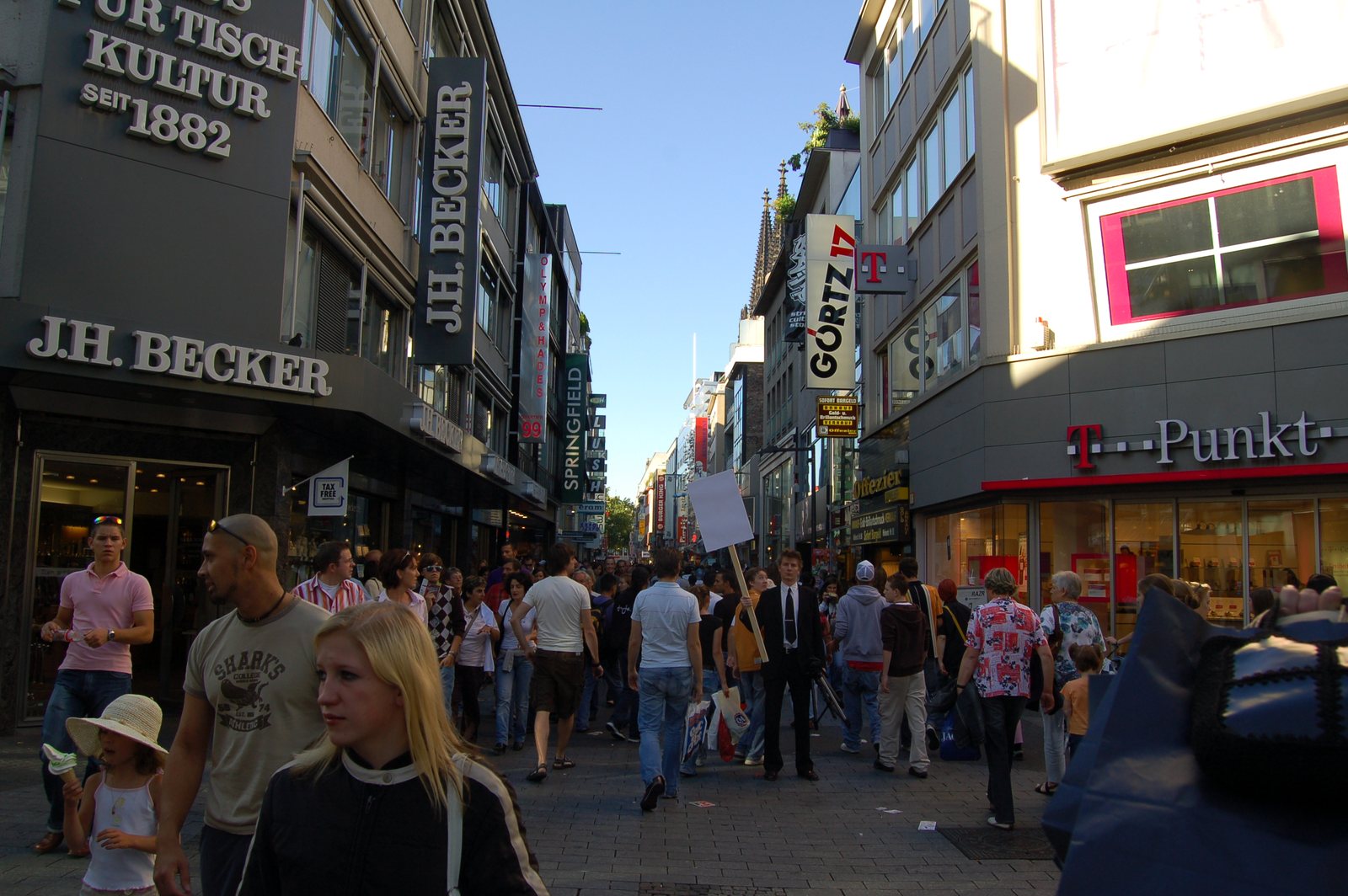
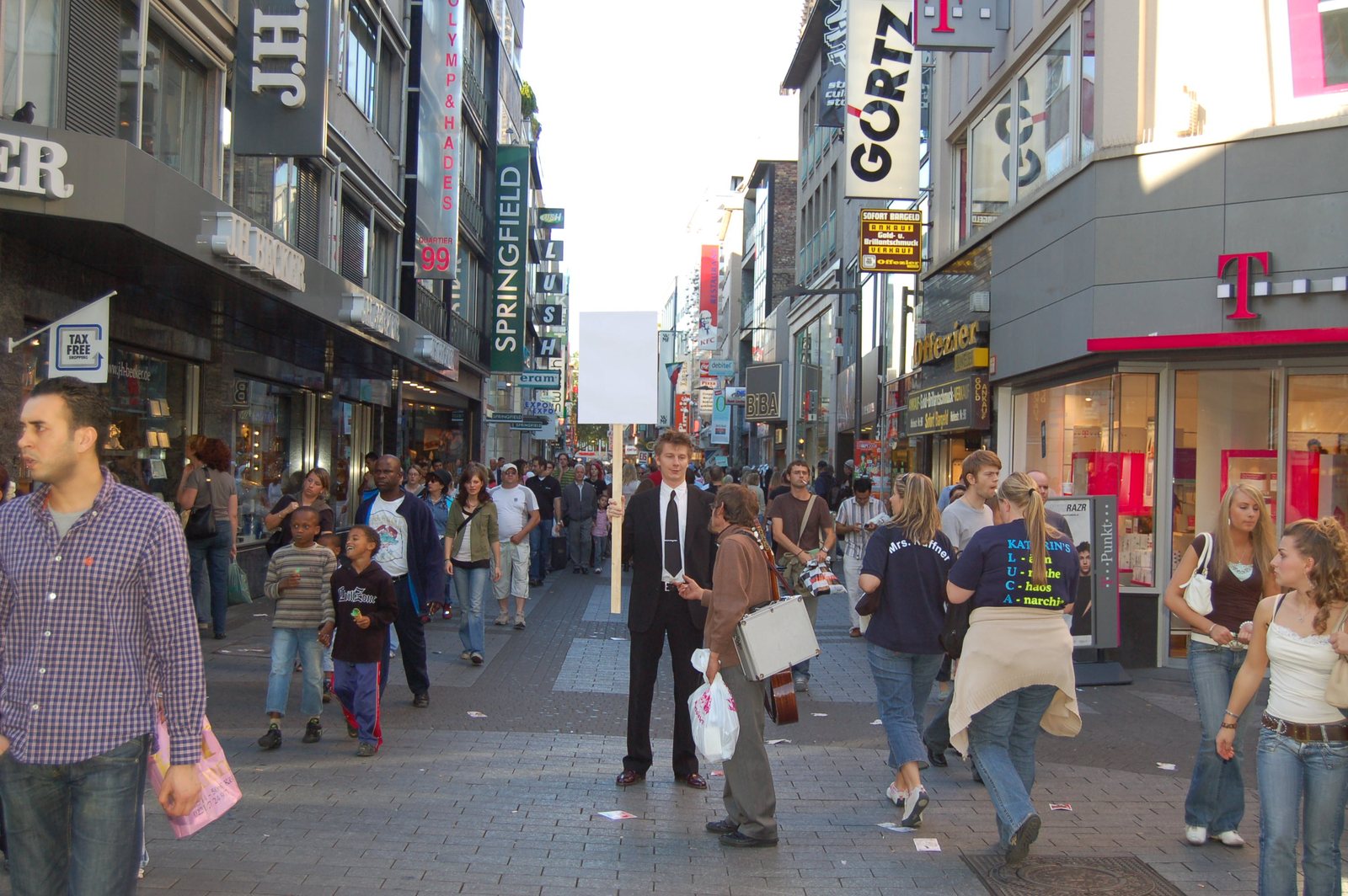
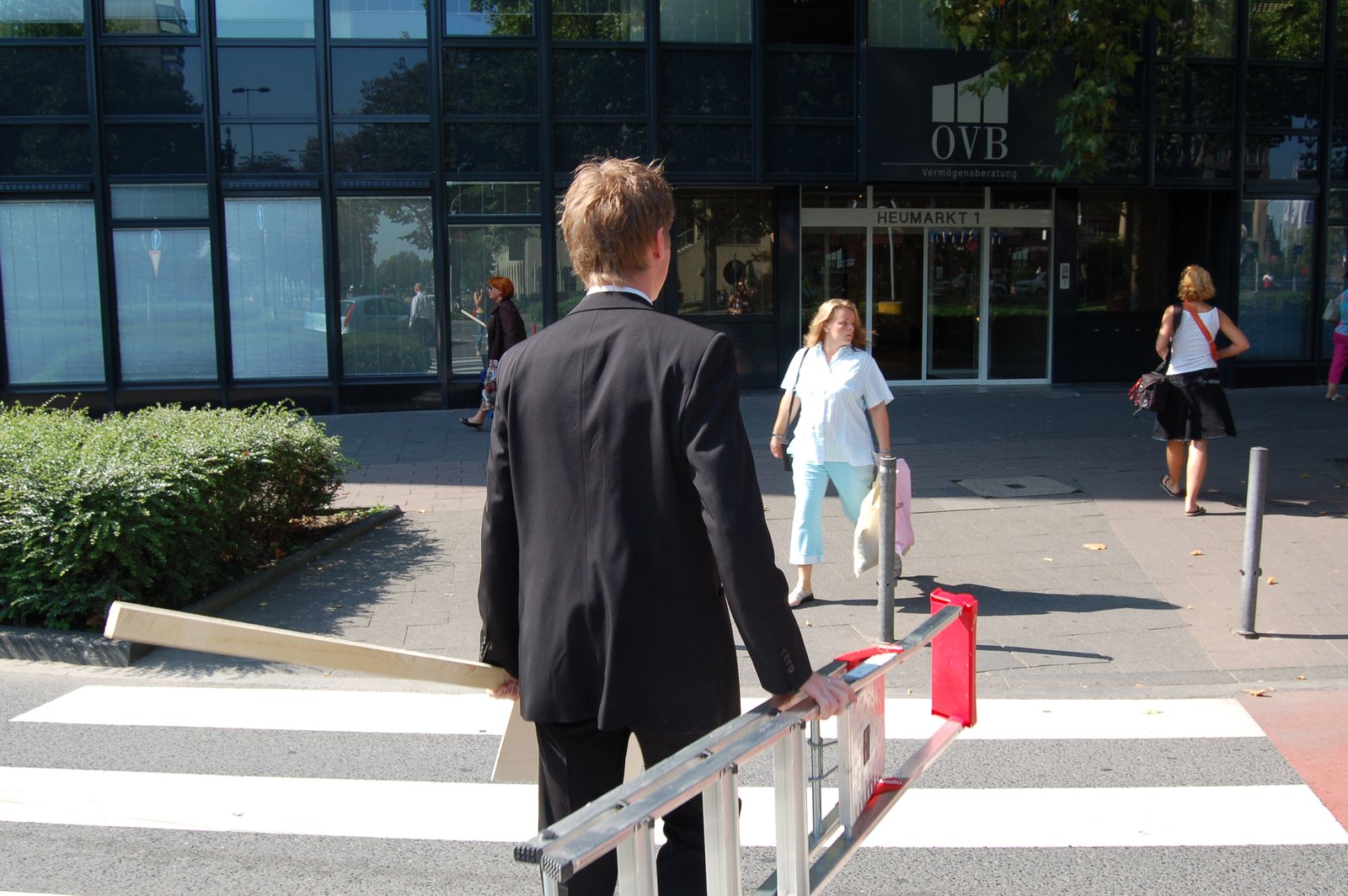
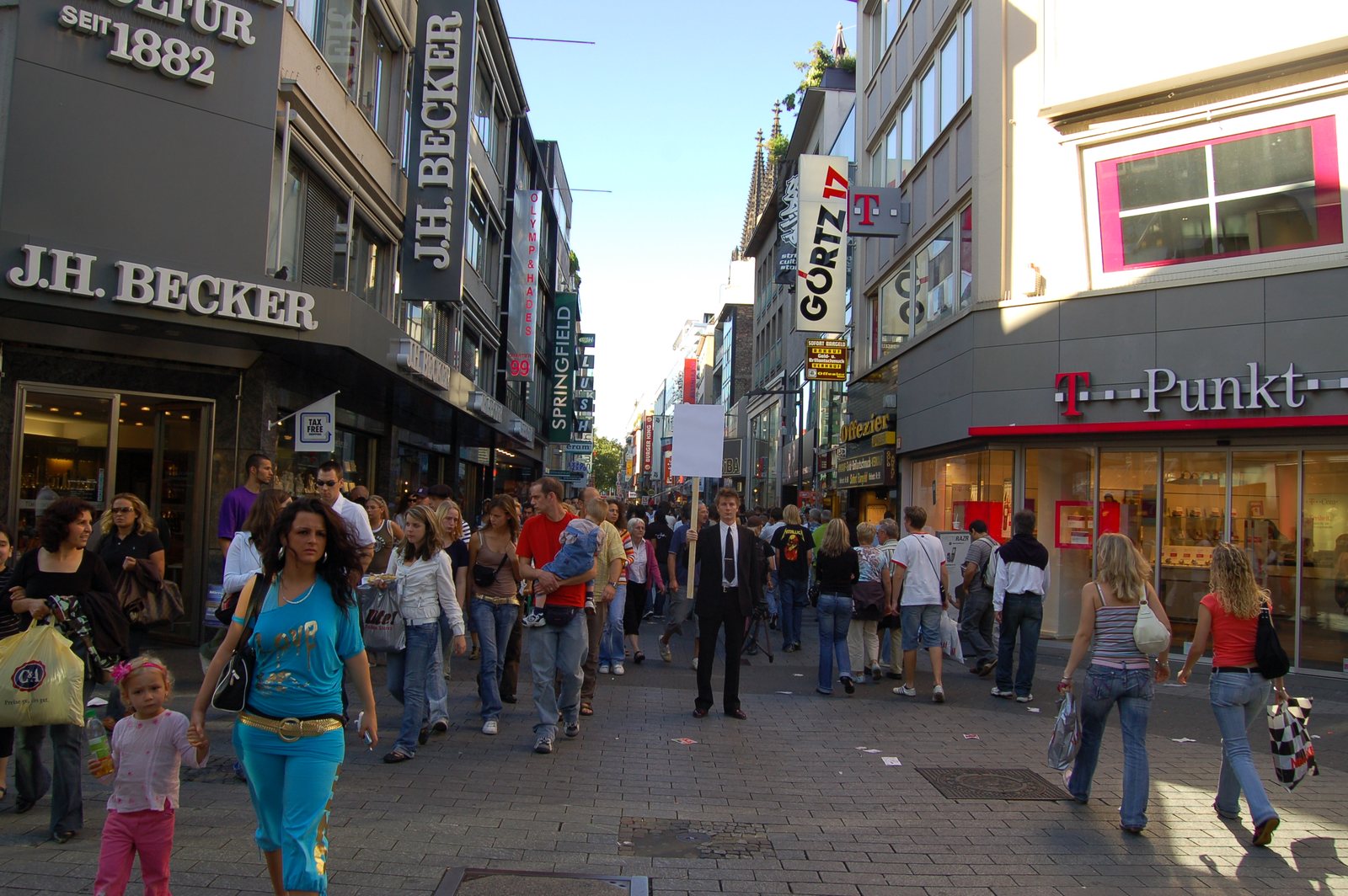
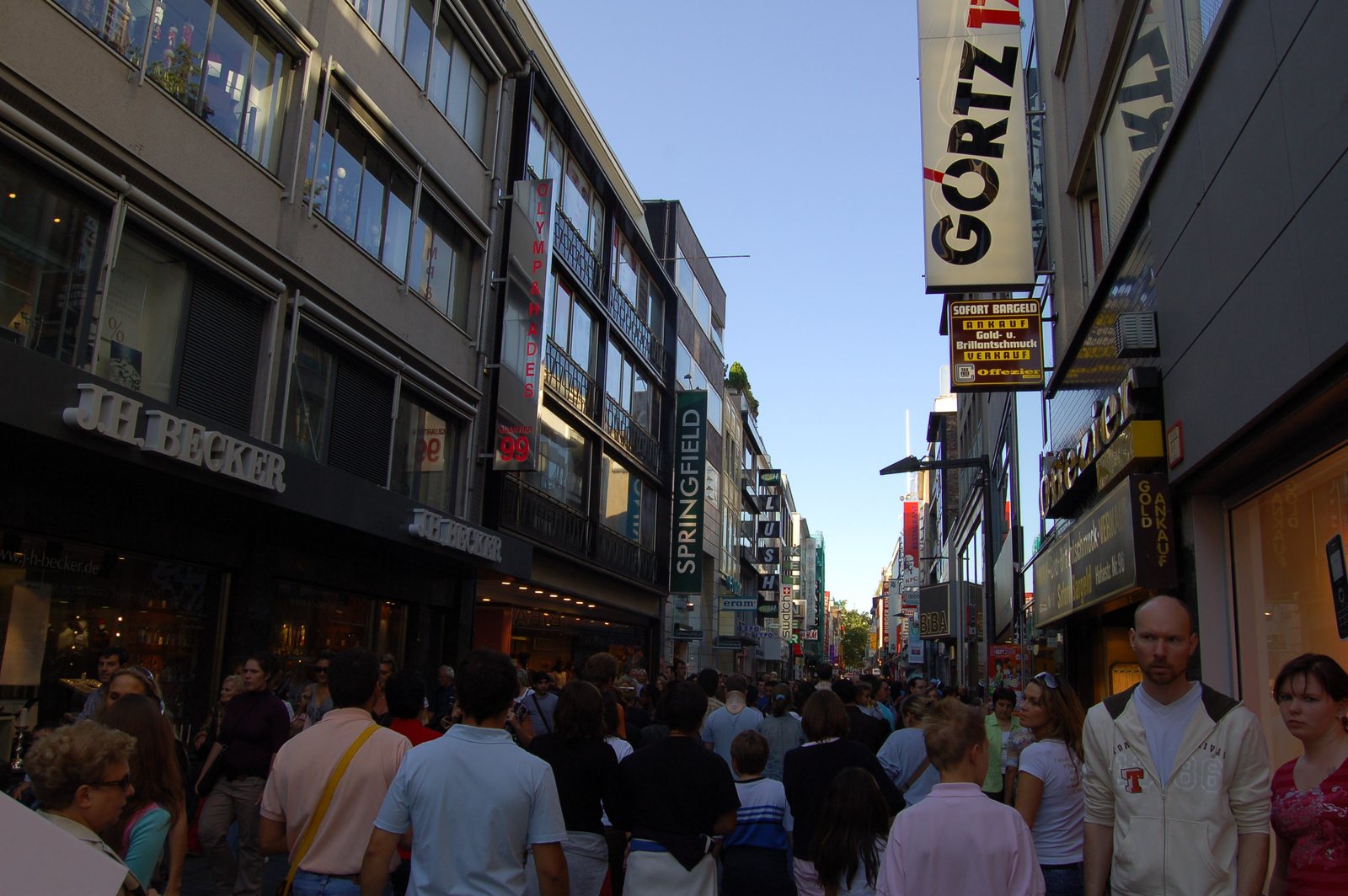
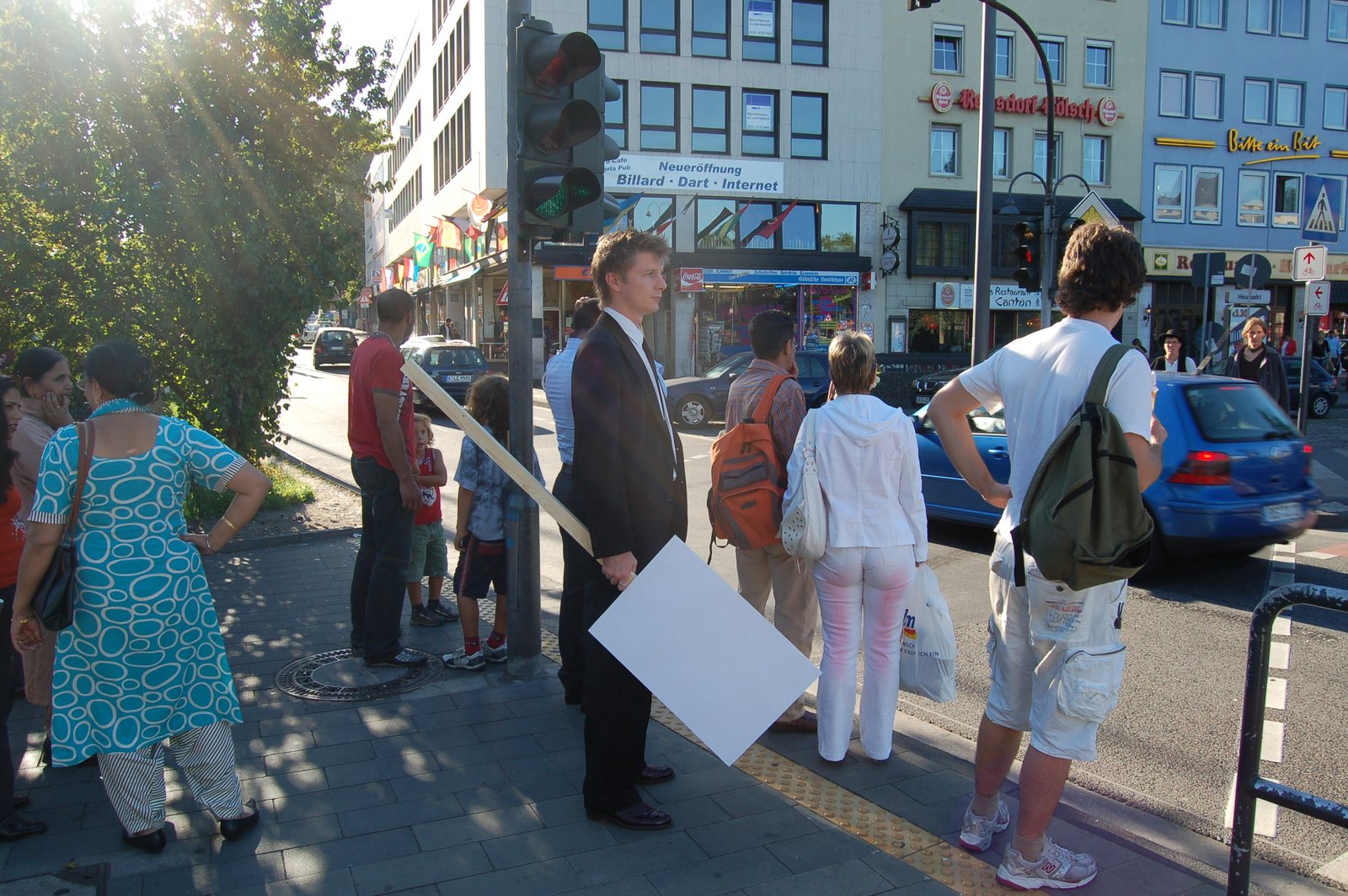
On two September days in 2006 a man in a black business suit walked the Hohe Straße, Cologne's busiest shopping street, carrying a blank white sign. He advertises nothing and demands nothing; the empty placard turns the spectacle of the shopping street into a stage and leaves the passers-by to fill it. Public space as the surface waiting for its content.
the two spaces
Two bodies of work carry the hybrid space out of theory and into practice. They are documented on their own.
The whole apparatus of the exhibition, realised in-world: vernissage, artist talks, a talk to Berlin and a finissage, performed by avatars and streamed between Cologne and the grid — with the physical echo at PACT Zollverein in Essen.
Two live events that connect first and second life in real time: the i buy everything event (2006) and the going mobile event (2007) — money, eros and the shopping mall, streamed both ways.
projects — floriankuhlmann.com